
Does SMP Make Sense?
Most people who ask me whether scalp micropigmentation is worth it already know what they don’t want: another hat, another angled Zoom call, another year of “maybe next month” with finasteride. What they are less clear on is what SMP actually buys them, and whether that matches how they plan to wear their hair for the next five years. I run Vicky’s Hair Tattoo in San Gabriel and see clients from Los Angeles, Pasadena, and the surrounding valley. The honest answer is that SMP is worth it for a specific type of goal. Outside of that, you are paying for the wrong tool.
What you are paying for (and what you are not)
Scalp micropigmentation deposits pigment into the upper skin layer to mimic the look of hair follicles and a defined edge. It does not create follicles. Hair does not grow from the dots. If someone tells you SMP is “like a hair transplant but cheaper,” they are comparing two different outcomes.
What SMP does well is cosmetic framing. A sharp hairline on a short buzz, less visible scalp shine between existing hairs, and camouflage on scars or alopecia patches when the hair is kept at a #0 to #2 guard. What it cannot do is give you length, movement, or coverage when you wear your hair longer than about a #4 guard. Past that length, the dots can become visible and the illusion breaks.
That limitation is not a small detail. It is the main reason consults go wrong when someone wants SMP but plans to grow their hair out “just a little” in six months. I would rather decline the appointment than set up that mismatch.
Hairline tattoo vs hair transplant
Clients often arrive with two browser tabs open: SMP studios and FUE clinics. The procedures solve different problems.
A hair transplant moves living follicles from a donor area, usually the back and sides of the scalp, into thinning or bald areas.
When successful, transplanted hair can grow and be cut like natural hair. The trade-offs include surgery, recovery time, donor-hair limitations, and a much longer timeline before the final result can be judged.
SMP works differently. It does not move or grow hair. Instead, pigment is used to recreate the visual appearance of closely shaved follicles or reduce the contrast between thinning hair and the scalp.
A hairline tattoo (SMP) is non-surgical pigment work. There is no donor harvest, no graft survival phase, and no growth cycle. You are buying the appearance of density and a clean line while hair is worn short. For recession, diffuse thinning on top, alopecia patches, or scar blending, that can be enough. For someone who wants to run their hands through longer hair, it will not be.
| If your priority is… | Lean toward |
|---|---|
| Real hair length and styling | Transplant (if you are a surgical candidate) |
| Short buzz, defined line, less scalp show-through | SMP |
| Lowest upfront cost regardless of quality | Neither until you research the provider |
I keep a longer breakdown on hairline tattoo vs hair transplant for readers who want cost and medication context in one place.
When SMP tends to be worth the money
In practice, SMP is worth the money when three things line up: hair length habit, visual goal, and provider skill.
Hair length habit. You already buzz or you are willing to maintain a short crop indefinitely. Clients who treat SMP as temporary often regret it when they try to grow out.
Visual goal. You care about hairline shape, temple recession, crown shine in office lighting, or scar visibility more than total hair mass. Session two and three feedback in my studio usually centers on those issues, not on “thicker hair” in the literal sense.
Provider skill. Color that turns gray-blue, dots that are too large or too uniform, and hairlines drawn too low for the client’s age read as cosmetic work immediately. The best outcome I hear described is boring in a good way: a barber treats the hairline like a normal short buzz. If your barber clocks “work done” from across the chair, something in the pigment match or edge design was off.
Mini-scenario: a client with early temple recession who wears a #1 guard to work and wants photos without adjusting his cap. SMP on the edge plus light density in the thinning band can be worth it because his daily routine already matches what the treatment is designed for. A client with the same recession who wants to wear a #5 on weekends is usually a poor fit unless he accepts changing his length habit.
The Real Cost of SMP: What Determines Whether It Is Worth It
I answer these together in consult because a low price with the wrong timeline or pain tolerance still wastes your money.
Price matters when deciding whether scalp micropigmentation makes sense, but the amount you pay depends on the size of the treatment area, your existing hair density and how much coverage is needed.
Rather than repeating all of our prices here, you can see the current treatment levels, examples and starting prices in our complete Hair Tattoo Cost Guide.
Time. SMP is normally built over multiple appointments rather than trying to create the entire result in one session. The number and length of appointments depend on the treatment area and the result being created.
Comfort. Everyone experiences scalp micropigmentation differently. Some areas of the scalp can feel more sensitive than others. If discomfort is one of your concerns, read our guide on what a hair tattoo feels like.
Pros and cons (decision checklist)
Pros
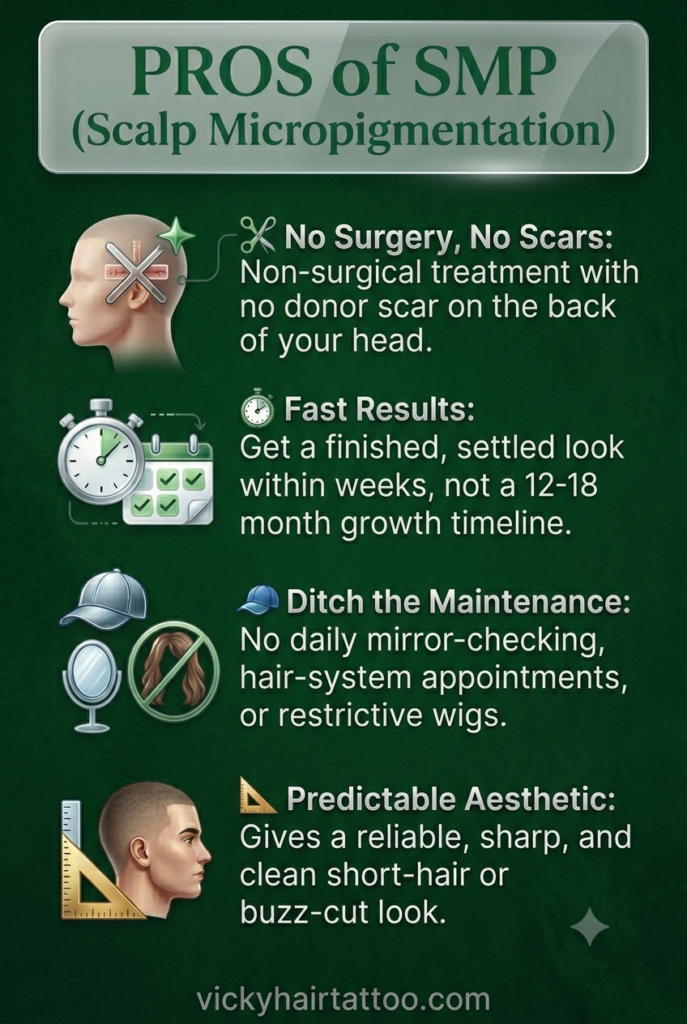
- Non-surgical, no donor scar on the back of the head
- Predictable short-hair aesthetic when pigment and design are done well
- Faster finished look for many clients than a surgical growth timeline
- No wig maintenance or hair-system appointments
Cons
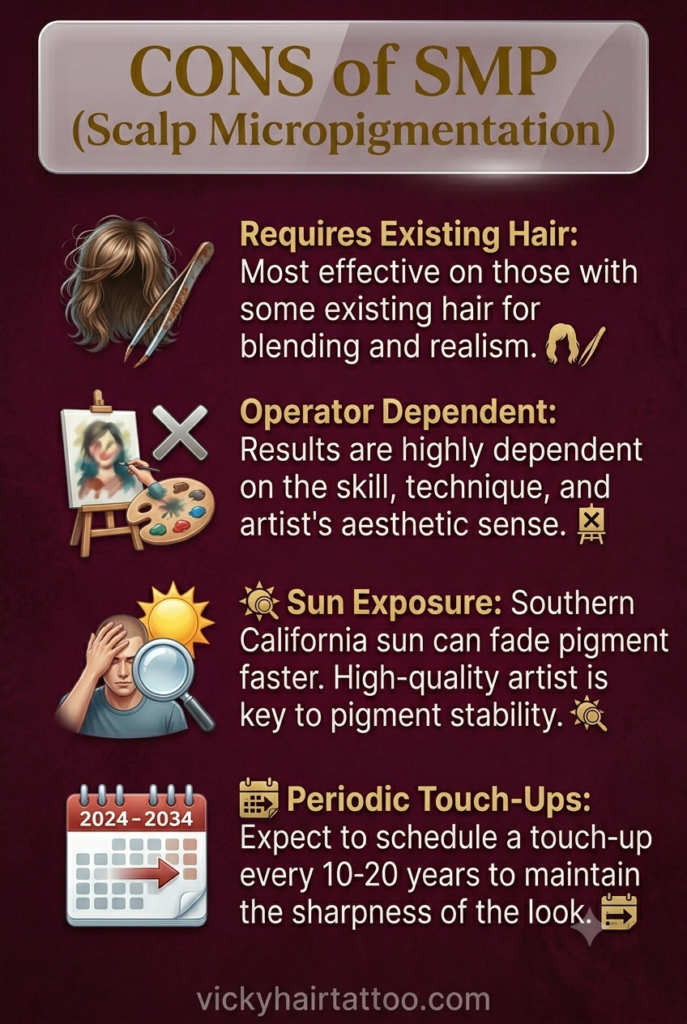
- No real hair growth; length expectations must stay realistic
- Requires ongoing short length; visible dots if you grow hair out
- Outcome depends heavily on artist skill; poor SMP is expensive to fix
- Sun exposure in Southern California can fade pigment faster without protection
- Touch-ups over the years should be planned, not treated as failures
If several cons are non-negotiable for you, SMP is not worth it no matter who performs it. I say that in consult when it applies.
Who should book a consult (and who should not)
Book if you want a defined short hairline, less scalp show-through on a buzz, or scar/alopecia help without surgery, and you will keep hair short.
Pause if you want long styled hair from pigment alone, if you are choosing purely on lowest price, or if you are not willing to review healed work on skin tones similar to yours.
I am biased because I provide SMP. I still refer candidates to transplant surgeons when length and native hair are the actual goal. A consult should end with a clear yes, a clear no, or a clear “not yet.”
Vicky’s Hair Tattoo · 633 S San Gabriel Blvd STE 208, San Gabriel, CA 91776 · (213) 826-4784 · Book a free consult
Related reading: hairline tattoo Los Angeles · before and after results · blog
FAQ
Is SMP worth it compared with a hair transplant?
Worth it if you want a short-hair look and cosmetic density, not if you need real growing hair. Many clients compare both; the right choice follows your length goal and timeline, not which ad they saw last.
Is SMP Worth the Cost?
SMP can make sense if your goal is a stronger-looking short hairline, less visible scalp, or the appearance of closely shaved follicles without surgery.
Whether it is worth the investment depends on whether that result matches how you actually want to wear your hair and what you expect SMP to accomplish.
For current treatment prices, hair-loss levels, and pricing examples, see our complete Hair Tattoo Cost Guide.
How long until SMP looks normal?
Many clients feel comfortable with the result within weeks after the final session, with healing between sessions. Full plans commonly use three sessions over several weeks.
Does SMP hurt?
Most clients describe tattoo-like sensation, with the frontal hairline often the most sensitive area. Discomfort varies by person. See is a hair tattoo painful? for what to expect in the chair.
How long does scalp micropigmentation last?
Many clients go 3 to 5 years before a touch-up, depending on sun exposure and skin. Fading is gradual; planning a refresh is normal, not a sign the original work failed.